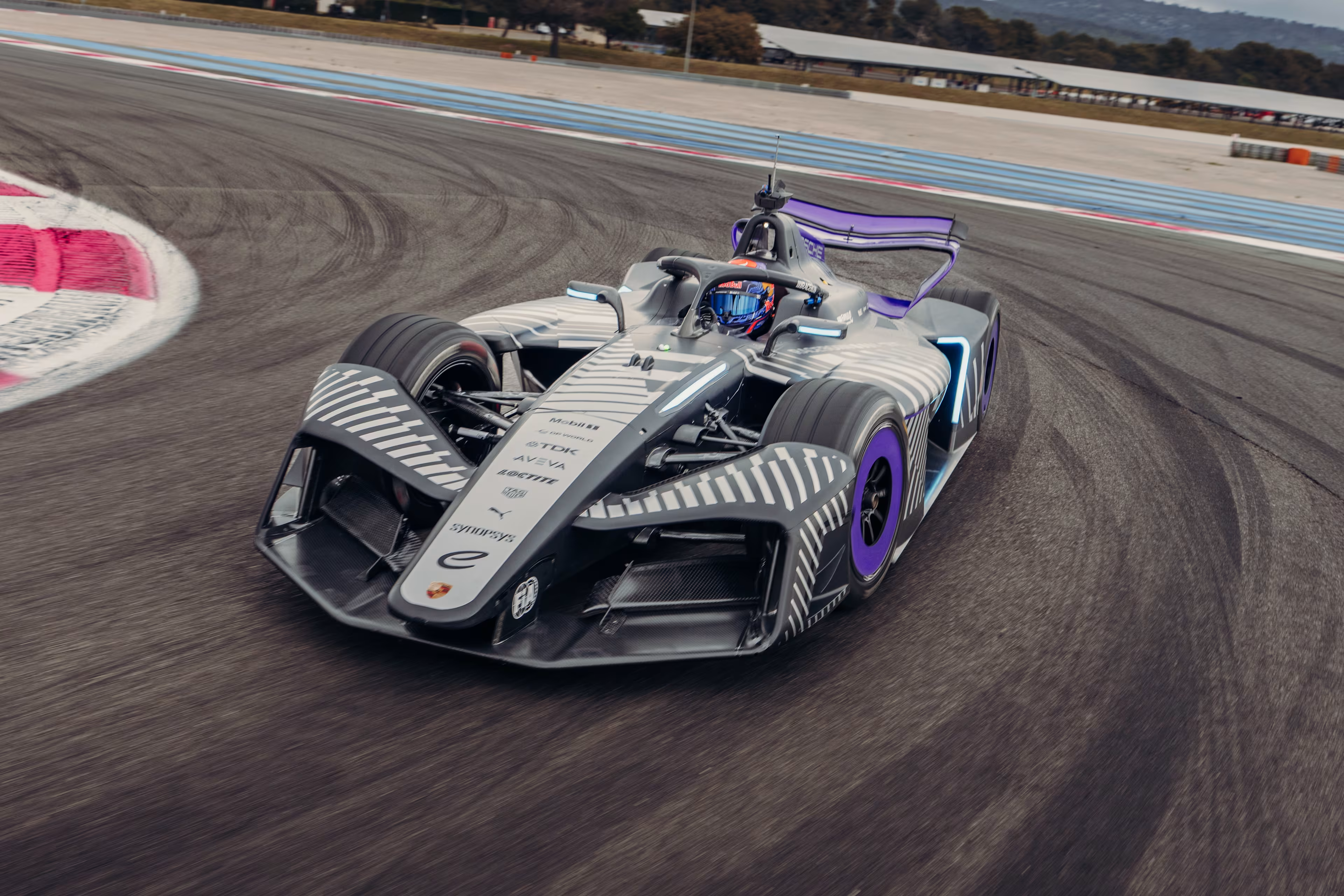
Nico Mueller was one of three drivers to sample the Porsche GEN4 Formula E car at the Autodromo Nazionale Monza last week, and the winner of one of last season’s Berlin E-Prixs believes that it is something of a landmark for the all-electric World Championship.
Porsche’s surprise test at one of motorsport’s most legendary circuits gained a huge amount of publicity, and it was for good reason. Monza would have been unfathomable for a GEN2 or even perhaps a GEN3 to have a productive test at, but the increased power and speed of the GEN4 has shown that the all-electric car has indeed reached a certain maturity.
FEN reported yesterday that the car is already on a par with F2’s pace, as it matched the lap record set by Kush Maini in 2024. But with further development and advancement in fundamentals, such as how to use the Bridgestone tyres to their maximum, the GEN4 car could improve 2-3 seconds on its present guise ahead of a planned upgrade in 2028.

“We really didn’t know what to expect, but honestly it did feel good and fun,” Porsche factory driver, Nico Mueller, told Formula E Notebook yesterday.
“There were obviously high top speeds on what is typically a low downforce circuit but we did try and gather some data on both configurations (of downforce).”
That alluded to the fact Porsche tried both the high and low drag bodywork configurations at Monza. This was something that Mueller believes will have been particularly useful as the teams start to think about the pre-season test at Jarama next month and then the start of the first GEN4 campaign, presently still set for Jeddah in mid-December.
“When they are put in use, it’s quite different circumstances, so it is quite hard to compare. But we went through our program, learned quite a lot in in unique circumstances,” reckoned Mueller.
“We’re pretty confident that it will still be very valid data to go into the season with, and to get to know the car better in rather extreme conditions, so that whatever challenges are being thrown at us, we hopefully have a good database to base our decision making on.
“So generally, it has been a very exciting and interesting test with some pretty impressive lap times and performance around the track. I have to say that it makes us even more hungry for the season ahead.”
When asked how he thought the GEN4 car would handle behind other cars, Mueller was reticent to offer a firm opinion, notably because cars have not yet run in large groups. The busiest completed was in a four car test back in January at Monteblanco, when Stellantis, Jaguar, Nissan and Porsche shared track time together.

“It’s a bit difficult still to read into the behaviour in the pack around other cars,” he said.
“I think the dynamic in the sprint races and in the normal E-Prix is going to be very different because of the energy targets, but also because of the different downforce packages.
“So, the dirty air effect behind a low downforce package car or a high downforce package car will probably be quite different. This is something we’ll have to get a read on as quickly as possible, once we get on track with other cars.
“There are lots of things to get on top of in the very limited amount of time that remains in preparation for the season. But I can’t wait to really get stuck into it once also we get to Jarama and have the whole pack there and get a first feel for when we when we’re really close around the other cars.”