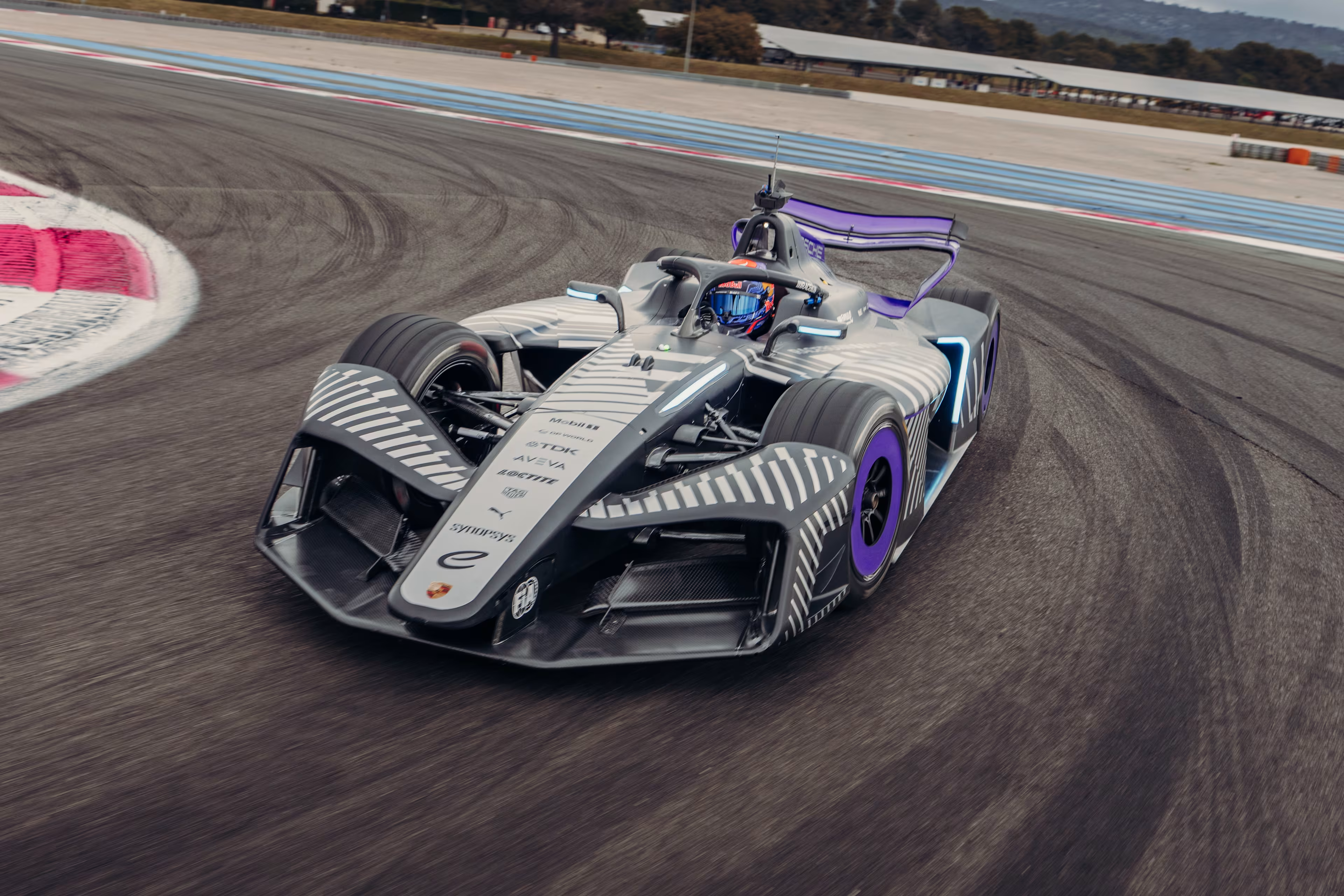
Porsche pivoted from its original intention to run a satellite team as a factory entity earlier this year, due to a complex amalgamation of topics that ensured the new Fusion Formula E Team could gain a rare chance to enter the grid.
Porsche announced its plans to field a second factory team last November. It was a scheme that had first been mooted, internally, back in 2024 and the German marque saw an opportunity to acquire the 12th and final Formula E licence slot. This was so it could achieve its objective of becoming the first manufacturer to have six cars on the Formula E grid and four of which would be run from Weissach.
That of course, would likely mean a full grid for the start of the GEN4 era. Formula E lauded the decision by Porsche. Life was good.
But……and there was a considerable ‘but’ here, and it came in the shape of a key threat to making this plan happen at all. This was the general health of the VW Group business through Porsche sales in the electric vehicle space and other tough industry challenges.
The downturn in EV demand—combined with U.S. tariff costs, the removal of EV/hybrid subsidies in key markets, and a steep drop in China—has heavily pressured Porsche’s overall financials, prompting the automaker to scale back its plan of reaching 80% EV sales by 2030 and refocus heavily on combustion and hybrid models like the 911.

There was also the decision in the summer of 2025 for Porsche to cease its global sportscar programme in the FIA World Endurance Championship, and of course Le Mans, a race synonymous with Porsche, as the most successful ever manufacturer there with 19 wins.
Its decision to vacate the FIA WEC just as it boomed was privately derided by Penske and publicly so by sections of its own fans. Then, swiftly, and to many unfathomably, there came the decision to double down on Formula E. There was confusion and let’s be honest, some derision too.
Porsche’s Formula E programme was in the middle of its success with multiple titles coming in the Gen3 era. The strategy of expanding the operation and also keeping numerical advantage over its rivals at Jaguar, Stellantis and Nissan was seductive. That was, until the complications as detailed above, became a stark reality.
Some probably believed simply that they were pulling out of WEC to be able to put more money into Formula E. That was not correct, and in fact was a bit of a lazy take on the situation.
Irrespective of that, the optics and timing were indeed poor. Let’s just call it a wrong sign. And, while we are on the topic signs, Porsche was also clearly keen to show one of its own in that they were not wasting money in the present difficult sales and business balancing climate. Hence the change in emphasis of its two extra cars heading in the customer direction in Formula E recently.
Through 2026 things were initially quiet and then they became deathly hushed around the planned team. Soon it became apparent that a stasis of sorts was occurring and that getting any decision from the top was not going to be forthcoming.
Yet the cars were ordered and the licence needed to be activated. Enter – Plan B.
Porsche’s view of the saga
How far advanced was Porsche in setting up the second team, and in retrospect, was the announcement of the additional factory cars premature?
“We deliberately made our intentions transparent in November in order to gain support
from existing and new partners. Most recently, we were faced with the decision of how to structurally anchor the second team,” said Porsche vice-president of motorsport, Thomas Laudenbach in a statement issued to FEN.
“At that point, we decided against the extra effort and in favour of maintaining the existing setup. The implementation would have only taken place in the next step.”
Originally, Porsche is believed to have favoured operating the second team from its Weissach R&D location, an approach that was certainly not met with universal enthusiasm from within the paddock generally.

Indeed, more complex requirements regarding the structural integration of such plans, are known to have been added by the rule’s makers and sanctioning body, the FIA.
This will have irritated Porsche greatly. Yet, in light of its other challengers this was actually probably not at the top of the absolute concerns that were holding its plans back.
Porsche has always underlined that the board had not approved any additional funding for the second team. So, from a business perspective, what did Porsche gain from the decision to switch to a second customer model?
“Sticking to two factory cars primarily avoids additional effort overall,” reckons Porsche director of Factory Motorsport, Thomas Laudenbach.
“This fits the company’s realignment in that we want to avoid or, ideally, reduce complexity in a number of areas,” added Laudenbach.
“But what is also important is that motorsport continues to shape our brand. And beyond that, in Formula E we continue to gather know-how for our electric sports cars.”
GEN4: Bring it on!
The reality of finding a second customer at such short notice was epic. The undulations of getting the Fusion Formula E crew on board were complex to say the least. The big question at hand now is – who owns the licence?
It is presumed that Porsche, who got the licence at what another entrant quipped to FEN last season as ‘mate’s rates’ still do, which might be troublesome along the way in Gen4. Certainly, Fusion will have autonomy to an extent but as they try and establish themselves and need inevitable Porsche support just to get started, how may that shape a future relationship from the sporting standpoint?
Then came the news at the beginning of September that Jaguar would have six cars on the grid, via not only a new spirited and ambitious team, but one that has been the operational and creative hub of the Big Cat’s Formula E challenge over the last decade – Fortescue Zero.
So, let battle commence!

Ultimately what we have here now, is a compromise of sorts. Porsche get their six car model, even if it is not as originally intended. Formula E and the FIA get a full grid with a new vibrant team, and Phil Charles get an opportunity to begin a whole new rivalry with Fortescue Zero, the new team that not only blindsided him last summer, but one that has a rich vein of bitter spice of being so closely linked to his old employee – Jaguar – who are now all-in with a virulent rivalry with intense nemesis, Porsche.
The appetites are wetted; the markers are laid down and the ammunition mother loads are loaded.
In a weird way, it is you the reader, the watcher and the consumer of Formula E that are the ultimate and absolute winners here.
That’s because as GEN4 hovers in to view, Formula E now has extra layers of intrigue, competition and entrants to help take it to a whole new level of exposure.